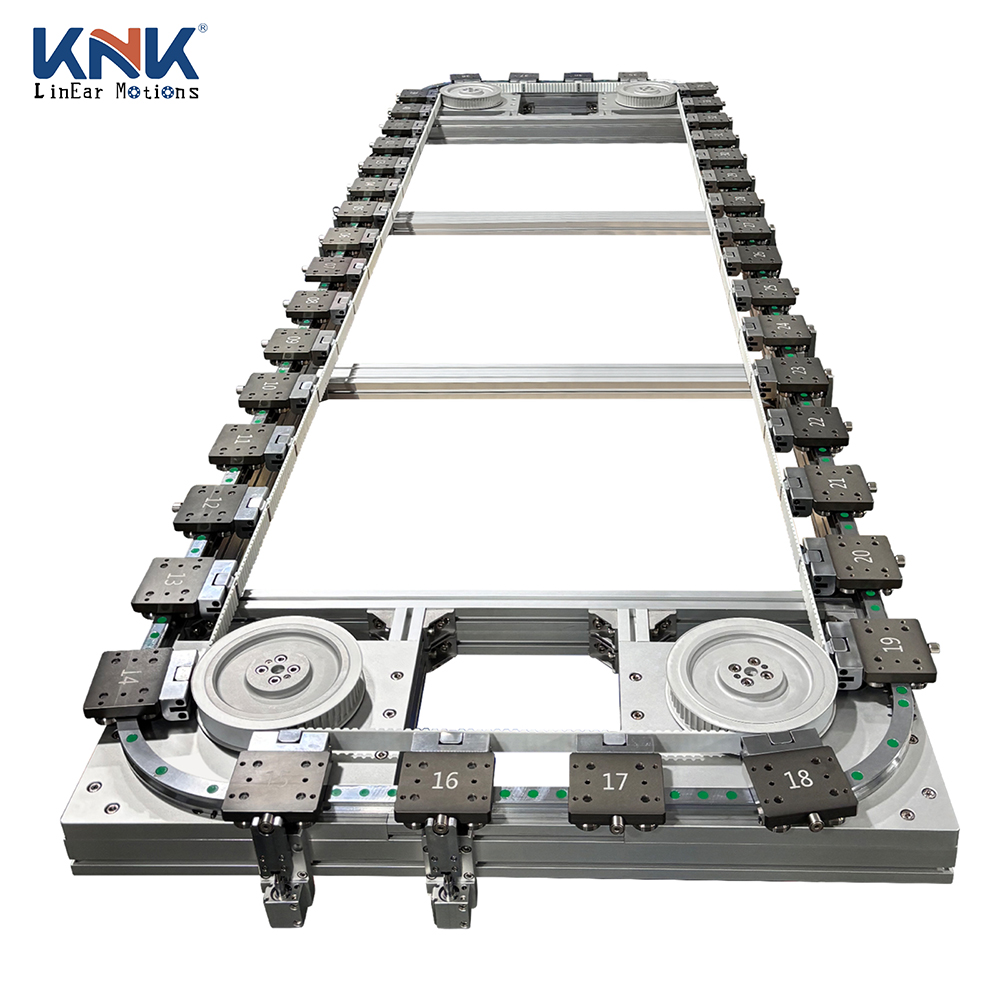
A belt driven rectangular loop conveyor is a closed-loop conveying system designed to transport products, pallets, fixtures, or workpieces continuously around a rectangular path. Compared with a conventional straight conveyor, its loop configuration allows multiple processes to be arranged along the same transportation system.
For OEMs, automation equipment manufacturers, and system integrators, a custom rectangular loop conveyor can be designed around the required product size, load, travel distance, positioning accuracy, speed, and production-line layout.
This makes the system suitable for applications where workpieces need to circulate between multiple processing stations rather than simply move from point A to point B.
A belt driven rectangular loop conveyor generally consists of a continuous belt or belt-based transmission system, guide components, drive units, support structures, and workpiece carriers.
The conveyor creates a rectangular or elongated loop, allowing products or fixtures to travel through multiple stations.
A typical production process may look like:
Loading → Assembly → Inspection → Processing → Testing → Unloading → Return
The closed-loop design means carriers can return to the starting area without requiring a separate return conveyor.
For custom automation, the rectangular loop can be configured according to the available factory space and the required number of workstations.
The biggest advantage of a rectangular loop conveyor is its continuous circulation path.
Products, pallets, and fixtures can move around the loop and return to the loading position after completing the required operations.
This is particularly useful for:
A rectangular conveyor system makes efficient use of floor space, especially when multiple workstations need to be positioned around the transportation path.
The overall configuration can be customized according to:
Instead of forcing the production process to follow a straight line, the conveyor can be designed around the actual production environment.
The belt drive provides continuous movement and is suitable for applications requiring smooth transportation over relatively long travel distances.
Depending on the system design, the drive configuration can be selected according to:
For applications that require accurate positioning at processing stations, the belt drive can be combined with suitable guides, sensors, motors, and control systems.
One of the main applications of a belt driven loop conveyor is connecting several processes within one automation system.
A single loop may contain:
This arrangement can simplify material flow and reduce the need for independent transfer mechanisms between every station.
When products are mounted on dedicated fixtures or pallets, the conveyor can continuously circulate these carriers through the production process.
This is useful when different operations require the workpiece to remain in a defined orientation.
Custom carriers can be designed according to:
For automated assembly and inspection, the relationship between the carrier and processing equipment is often as important as the conveyor itself.
The appropriate conveyor configuration depends on the actual production requirements.
Important parameters include:
A custom loop conveyor manufacturer should evaluate these parameters before selecting the belt, motor, guide system, drive components, and structural frame.
| Feature | Straight Conveyor | Rectangular Loop Conveyor |
|---|---|---|
| Material flow | Linear | Closed loop |
| Return path | Usually requires additional equipment | Integrated into loop |
| Multi-station production | Suitable | Highly suitable |
| Fixture circulation | Limited | Excellent |
| Layout flexibility | Moderate | High |
| Continuous circulation | Limited | Yes |
| Custom production cells | Moderate | Excellent |
A straight conveyor can be a better choice for simple transportation. A rectangular loop conveyor becomes more attractive when multiple processing stations and continuous fixture circulation are required.
A rectangular loop conveyor system can connect multiple assembly operations within one production cell.
For example:
Part Loading → Assembly → Fastening → Inspection → Testing → Unloading
Each workstation can be positioned along one section of the loop.
This configuration is suitable for electronics, automotive components, consumer products, and industrial equipment assembly.
Electronics assembly often requires several sequential processes with inspection between operations.
A loop conveyor can transport fixtures between:
The closed-loop design can also allow fixtures to circulate continuously during production.
Automotive components may require multiple automated operations before final inspection.
A custom loop conveyor can be integrated with:
The conveyor dimensions and carrier design can be customized according to the component being processed.
A precision loop conveyor can transport products through several inspection or testing stations.
For example:
Loading → Vision Inspection → Dimensional Inspection → Functional Test → Labeling → Unloading
If a product fails inspection, the control system can potentially route it for rework or additional testing, depending on the overall automation design.
Rectangular loop conveyors can work together with industrial robots.
Robots positioned along the conveyor can perform different operations while products circulate through the system.
Typical applications include:
The conveyor's speed and positioning should be coordinated with the robot cycle time.
For customized production lines, pallet-based transportation is often more practical than conveying products directly.
The belt driven rectangular loop conveyor can transport dedicated fixtures between different stations while maintaining a consistent product orientation.
This approach is useful when the workpiece needs to be accurately presented to robots, tooling, cameras, or testing equipment.
Standard conveyors may not provide the dimensions, positioning, carrier configuration, or station layout required by an OEM production line.
A custom conveyor system can be designed around the complete manufacturing process.
Customization may include:
Before selecting a conveyor, OEM customers should provide several basic parameters.
Provide:
Specify:
The manufacturer should understand:
Important technical requirements include:
These parameters determine the appropriate drive and guide configuration.
For OEM and custom automation projects, the conveyor should be considered as part of the complete production system rather than simply a material transportation device.
A properly designed system can combine:
Conveyor + Fixture + Drive + Sensors + PLC + Robot + Processing Stations
This integrated approach allows the conveyor layout, product positioning, and production sequence to be designed together.
For example, a customized rectangular loop conveyor system can be configured with different stop positions for different assembly stations while maintaining a continuous return path for the carriers.