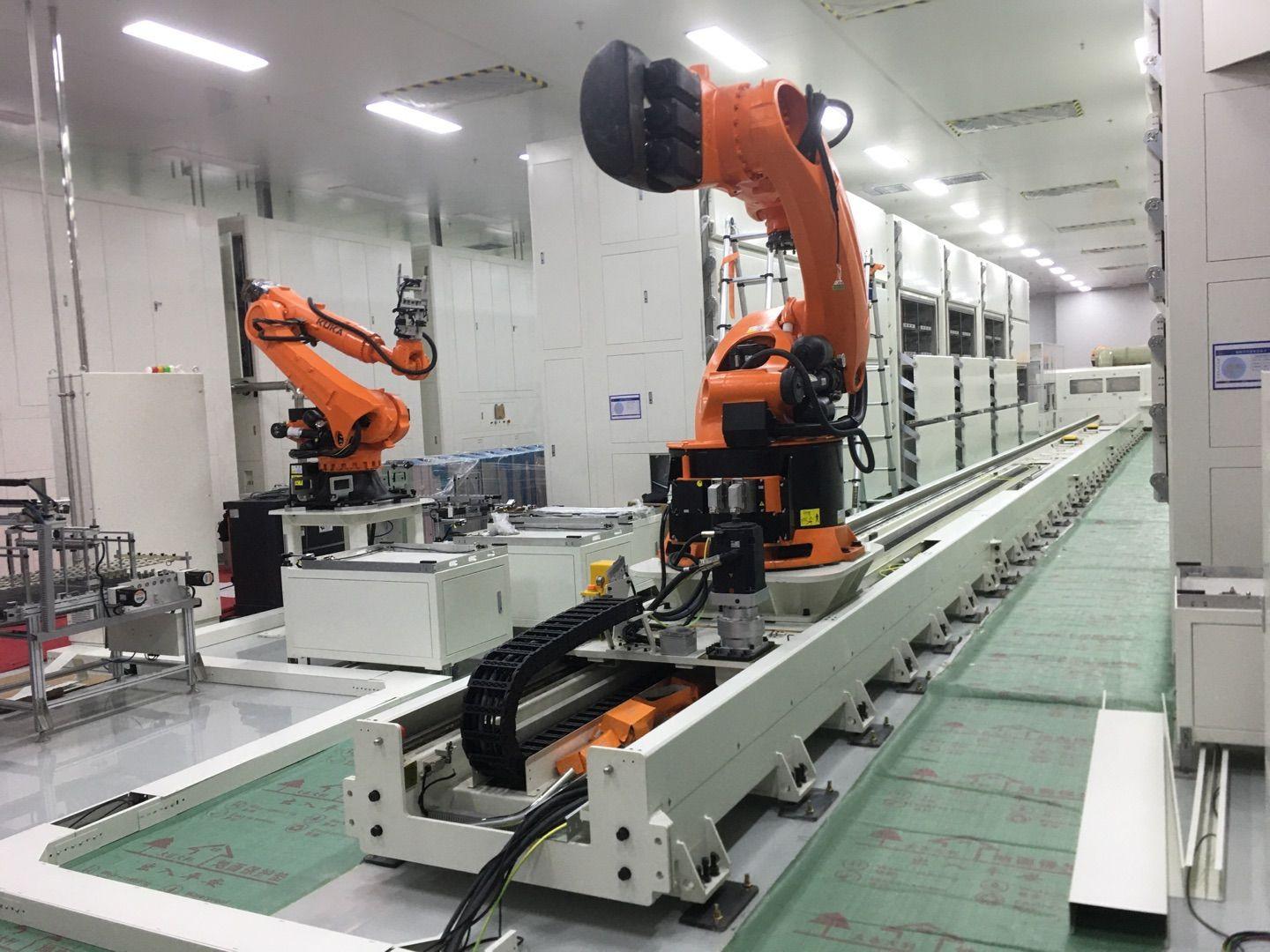
A 7th axis for robot is an external linear motion system that allows an industrial robot to move along a defined track or rail. Instead of keeping the robot fixed in one position, the additional linear axis expands its working range and allows it to serve multiple stations.
For manufacturers developing custom robotic automation systems, a 7th axis can be an effective solution when a conventional six-axis robot does not provide enough reach or when one robot needs to work across several production areas.
A robot 7th axis is typically installed underneath or alongside an industrial robot. The robot is mounted on a moving carriage, while a linear drive system moves the entire robot along the track.
Depending on the application, the system can use different drive technologies, such as:
The appropriate configuration depends on factors such as robot weight, payload, travel distance, speed, acceleration, positioning requirements and working environment.
The 7th axis does not replace the robot's existing six axes. Instead, it adds an additional degree of translational movement to the overall robotic system.
One of the main advantages of a 7th axis for robot is extended horizontal travel.
A fixed robot can normally operate only within its designed workspace. Adding a linear track allows the robot to move between different positions, significantly increasing the effective working area.
This is particularly useful for:
A robot mounted on a linear axis can serve several workstations instead of requiring a separate robot for each station.
For example, one robot may travel between:
Loading → Assembly → Inspection → Unloading
This can help reduce equipment duplication and improve the utilization of the robotic system.
Custom robot rail systems can be designed according to the required travel distance.
The actual stroke can be determined according to:
For custom automation, the track length should be calculated from the complete robot workspace rather than simply selecting the longest available rail.
A 7th axis must support more than the robot's nominal payload.
The design needs to consider the combined weight of:
For heavy industrial robots, the linear track and carriage need sufficient structural rigidity to minimize vibration and deflection during acceleration and deceleration.
For applications such as welding, assembly, dispensing and machine tending, the robot needs to reach repeatable positions along the external axis.
The positioning performance of a robot linear axis depends on factors including:
For demanding applications, the external axis can be integrated with the robot controller so that robot movement and linear-axis movement are coordinated.
A properly integrated 7th axis is more than a simple motorized rail.
The external axis can work together with the robot's six axes to create coordinated motion.
This is useful when the robot needs to:
This type of coordinated motion is especially valuable for customized robotic production lines.
| Feature | Fixed Robot | Robot with 7th Axis |
|---|---|---|
| Working range | Limited by robot reach | Extended by linear travel |
| Number of stations | Usually limited | Multiple stations possible |
| Large workpieces | More difficult | More flexible |
| Production-line integration | Moderate | High |
| Equipment utilization | One dedicated area | Can cover multiple areas |
| Layout flexibility | Lower | Higher |
| Customization | Moderate | High |
For applications requiring long-distance movement or access to several stations, a 7th axis robot system can provide greater layout flexibility than a fixed installation.
Large welding components may exceed the practical working range of a fixed robot.
A 7th axis linear track allows the robot to move along the workpiece and access different welding positions.
Typical applications include:
A robot mounted on a linear track can serve multiple CNC machines.
Instead of installing one robot for every machine, one robot can move between several machines for:
This makes the 7th axis useful for flexible manufacturing cells.
For long production lines, the robot may need to pick and place products at different locations.
A robot transfer axis can provide the additional travel required for:
A robot 7th axis can allow one robot to access multiple assembly stations.
The system can be configured with predefined stopping positions corresponding to individual workstations.
This approach is suitable for customized assembly lines where the number and location of stations may vary.
Large components require long and continuous robot movement.
A 7th axis linear track can extend the robot's effective workspace for:
The track design should take into account environmental conditions, contamination and cable protection.
Robotic inspection systems may need to scan components larger than the robot's normal reach.
An external linear axis allows the robot-mounted sensor or inspection tool to move along the component.
Potential applications include:
For custom projects, selecting the correct external axis requires more than considering travel length.
Key parameters should include:
The system should be designed around the actual robot model, mounting configuration and total moving mass.
Calculate the required stroke based on the positions that the robot must reach.
Consider the complete moving load, including the robot, tooling and other equipment mounted on the carriage.
High-speed applications require a drive system and mechanical structure capable of handling the required acceleration without excessive vibration.
Different applications have different requirements for positioning accuracy and repeatability. Welding, handling and inspection applications may require different performance levels.
The external axis may be installed:
The installation method affects the mechanical design and load calculation.
The 7th axis should be compatible with the robot controller and the required motion-control architecture.
Standard robot tracks may not always match the requirements of a custom production line.
For OEM customers and system integrators, a custom robot 7th axis can be designed around the actual application.
Customization may include:
The objective is to develop the linear axis as part of the complete robotic system rather than treating it as an independent component.
Adding another robot is not always the best solution when several workstations are located along one production line.
A 7th axis for robot may allow one robot to cover multiple working positions while maintaining a compact automation layout.
However, the decision should be based on:
For high-volume applications requiring simultaneous operations, multiple robots may still be preferable. For applications where one robot can efficiently serve multiple stations, an external linear axis can provide a more flexible solution.