Modern manufacturing requires automation systems that can move products and tools accurately, repeatedly, and efficiently. For applications that require controlled movement in three dimensions, a Robot XYZ system provides a practical solution based on X, Y, and Z linear motion.
An XYZ robot can move along three perpendicular axes, allowing automated equipment to reach different positions within a defined working area. Compared with robotic arms that rely on multiple rotary joints, an XYZ robotic system uses linear motion to create predictable and programmable movement.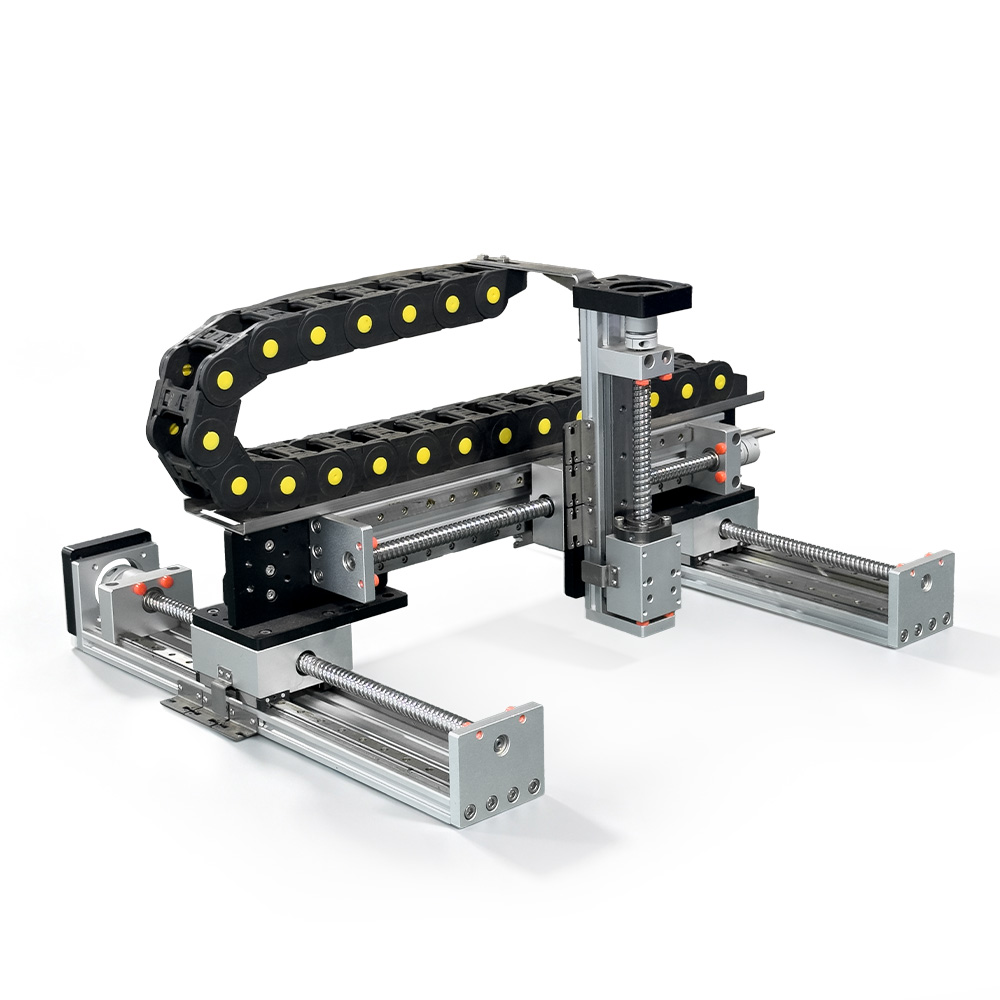
For OEM machine builders and automation integrators, a custom XYZ robot can be designed around specific requirements for X/Y/Z stroke, payload, speed, positioning accuracy, repeatability, working area, mounting method, and end-of-arm tooling.
A Robot XYZ is a three-axis Cartesian robotic system that moves along three linear directions:
The three axes work together to position a tool, gripper, camera, or workpiece within a three-dimensional workspace.
A typical XYZ robot may include:
Depending on the application, different linear drive technologies can be selected, including belt drive, ball screw, rack and pinion, or linear motor systems.
The basic working principle is straightforward:
Motion Command → Motor Drive → Linear Movement → XYZ Positioning → Automated Operation
During a typical cycle:
By coordinating the three axes, the robot can perform complex three-dimensional movement while maintaining a relatively simple mechanical structure.
Standard XYZ robots are suitable for many applications, but OEM machines often have unique requirements.
A custom XYZ robot allows engineers to design the system according to the actual production process.
Common customization parameters include:
Instead of changing the machine layout to accommodate a standard robot, the XYZ system can be configured around the machine.
An XYZ robot provides controlled movement along three linear axes.
This makes it suitable for applications requiring repeatable positioning, such as:
The achievable accuracy depends on the selected linear modules, mechanical structure, motor, encoder, controller, and operating conditions.
The working envelope can be customized by changing the travel length of each axis.
For example:
This makes XYZ robots suitable for both compact machines and large automation systems.
Different axes do not necessarily need to use the same drive mechanism.
A customized system can combine:
Suitable for applications requiring:
Suitable for applications requiring:
Can be considered for:
Suitable for applications requiring:
The appropriate drive should be selected based on the required speed, payload, stroke, accuracy, and duty cycle.
One of the most common applications for an XYZ robot is automated pick and place.
A typical sequence is:
Pick → Lift → Move → Lower → Release → Return
The system can move products between:
Depending on the product, the end-effector may use a vacuum gripper, electric gripper, pneumatic gripper, or customized fixture.
XYZ robots can also be integrated into automated assembly equipment.
Potential applications include:
The linear motion structure provides predictable movement between predefined assembly positions.
For multi-station production, the robot can be programmed to perform a sequence of movements automatically.
A custom XYZ robot can load and unload components from industrial equipment.
For example:
Part Loading → Machine Processing → Part Unloading → Inspection
Potential equipment includes:
This can reduce manual handling and improve production consistency.
A three-axis robot can move a dispensing head along programmed X, Y, and Z paths.
Applications include:
For these applications, the motion system needs to be selected according to the required path accuracy, speed, and process consistency.
An XYZ robot can position a camera, sensor, or product at specific inspection locations.
Typical applications include:
The repeatability of the XYZ positioning system helps maintain consistent inspection conditions.
For OEM applications, customization is often more important than simply selecting a standard robot.
The three axis travel distances can be configured according to the required working envelope.
Payload calculations should include:
The required speed depends on:
The required performance should be defined according to the actual application.
For example, a material transfer application may have different positioning requirements from a precision assembly or inspection system.
An XYZ robot can be configured for different machine structures, including:
| Feature | Robot XYZ | Industrial Robot Arm |
|---|---|---|
| Motion | Linear XYZ axes | Rotary joints |
| Movement | Structured linear movement | Multi-directional |
| Long Linear Travel | Excellent | More complex |
| Working Envelope | Usually rectangular | Flexible |
| Precision Positioning | Excellent for suitable designs | Excellent |
| Programming | Relatively straightforward | More complex |
| Customization | Excellent for linear applications | Excellent for complex applications |
| Typical Uses | Pick & place, assembly, inspection | Welding, handling, complex assembly |
An XYZ robot is often a good choice when the application mainly involves structured linear movement within a defined working area.
An industrial robot arm may be preferable when the application requires complex orientation, multiple approach angles, or movement around obstacles.
The terms Robot XYZ and 3-axis gantry robot are often used to describe similar automation concepts.
A 3-axis gantry robot generally uses an overhead or supporting frame to position the X, Y, and Z linear axes.
A Robot XYZ system can refer more broadly to any three-axis Cartesian robotic configuration.
In many industrial applications, the two concepts overlap significantly.
When sourcing a Robot XYZ manufacturer, OEM customers should evaluate both the product and the supplier's engineering capabilities.
The manufacturer should be capable of evaluating:
The supplier should be able to customize:
The XYZ robot may need to communicate with:
A supplier with system integration experience can simplify the overall automation project.
Before requesting a quotation, OEM customers should provide as much application information as possible.
This information allows the manufacturer to select the correct linear modules and develop a suitable XYZ configuration.
A professional XYZ robot manufacturer can customize the system at multiple levels.
This makes XYZ robots suitable for highly specialized OEM equipment.
Custom XYZ robots can be applied in: