Industrial automation systems often require different combinations of travel distance, payload, speed, positioning accuracy, and working area. A standard gantry robot may not always fit the mechanical structure or production requirements of a specialized machine.
A Customize Gantry Robot solution allows OEM manufacturers and automation integrators to build a gantry system around the actual application instead of adapting the machine to a fixed standard configuration.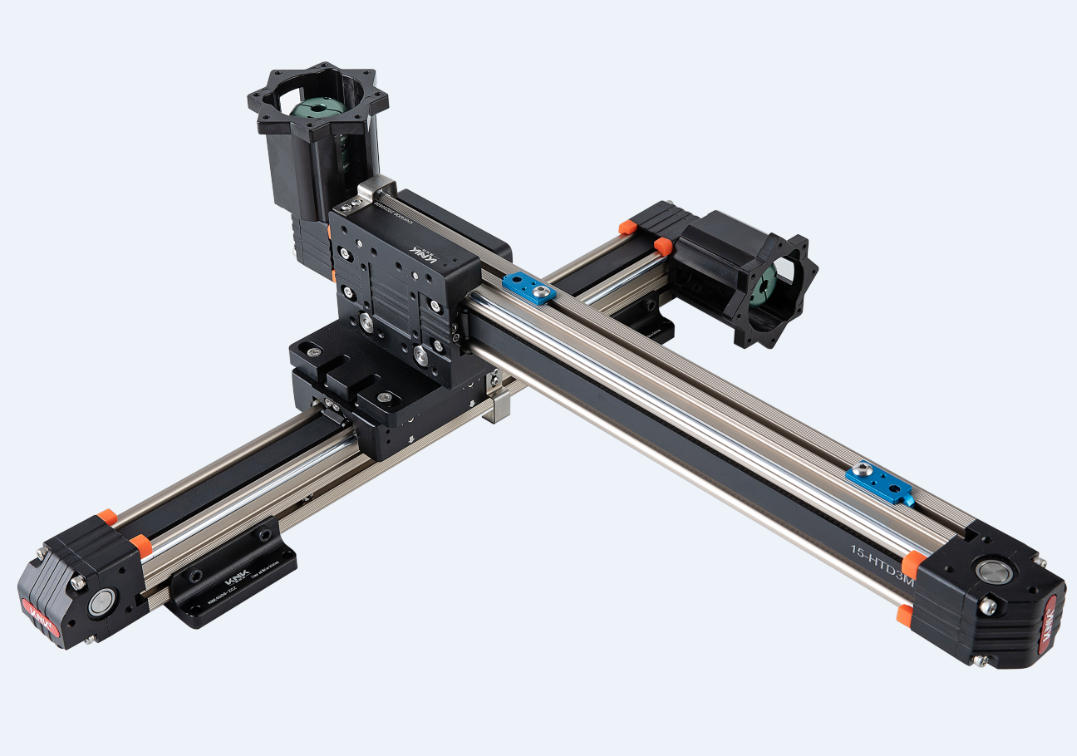
A customized gantry robot can be designed with different axis lengths, drive mechanisms, motors, guides, controllers, and end-effectors. Depending on the application, the system can support pick and place, material handling, automated assembly, machine tending, dispensing, inspection, and other industrial processes.
A gantry robot is an industrial automation system that uses linear axes mounted on a supporting structure to move a tool, gripper, or workpiece.
A typical configuration may include:
A 3-axis gantry robot normally provides:
X-axis → Horizontal movement
Y-axis → Cross-axis movement
Z-axis → Vertical movement
By coordinating the three axes, the robot can position products or tools within a defined three-dimensional workspace.
Every automation project has different mechanical and production requirements.
For example, one machine may require:
Another application may require:
A standard gantry robot may not be optimized for both applications.
With a customized gantry robot, the system can be developed according to the specific requirements of the machine.
When designing a custom gantry robot, several parameters should be considered.
The X, Y, and Z stroke determines the robot's working envelope.
The axis lengths can be customized according to:
Long-travel applications may require different mechanical structures from compact automation equipment.
Payload should include the total moving weight.
This may consist of:
The payload requirement affects the selection of the linear module, guide system, motor, and supporting structure.
Robot speed should be selected based on the required production cycle.
A high-speed pick-and-place system may prioritize rapid acceleration and short cycle time, while a precision assembly system may prioritize controlled movement and positioning stability.
Important factors include:
Different applications require different positioning performance.
For example:
Material Transfer: moderate positioning requirements
Pick and Place: repeatable positioning
Precision Assembly: higher positioning requirements
Inspection: stable and repeatable positioning
The complete system design should consider the linear guide, drive mechanism, motor, encoder, mechanical structure, and controller.
Different drive mechanisms can be used according to application requirements.
A belt-driven axis can be considered for applications requiring:
It is commonly used for material handling and high-speed automation.
Ball screw-driven axes are suitable for applications where controlled and accurate linear positioning is important.
Typical applications include:
Rack-and-pinion systems can be considered for certain long-travel and higher-load applications.
They are particularly useful when the robot needs to cover a large working area.
Linear motor technology can be considered for applications requiring:
The appropriate drive mechanism should be selected according to the actual payload, stroke, speed, accuracy, and operating cycle.
A 3 axis gantry robot is one of the most common configurations.
The three axes provide:
X + Y + Z
This allows the robot to perform three-dimensional movement.
A custom 3-axis gantry robot can be configured for:
For OEM customers, this provides flexibility when integrating the robot into an existing production line or custom machine.
Pick and place is one of the most common applications for gantry automation.
A typical operating sequence is:
Pick → Lift → Move → Lower → Release → Return
Custom gantry robots can transfer products between:
Different grippers can be integrated according to the product.
Possible end-effectors include:
Gantry robots can perform repetitive assembly movements with controlled positioning.
Applications may include:
For multi-station assembly systems, the robot can be programmed to move between predefined positions.
A gantry robot can automate the loading and unloading of industrial machines.
For example:
Raw Part → Machine Loading → Processing → Unloading → Inspection
Applications may include:
The gantry structure can be customized according to the machine layout and transfer distance.
A gantry robot can move cameras, sensors, or workpieces to predefined inspection positions.
Possible applications include:
For inspection applications, stable and repeatable positioning is important because the inspection equipment must reach consistent locations.
A customized gantry robot can move a dispensing head along programmed paths.
Applications include:
The required axis accuracy and speed should be selected according to the dispensing process.
OEM machine builders often require more than a standard robot.
A complete customized solution may include:
This approach allows the gantry robot to be integrated directly into the customer's machine architecture.
| Feature | Standard Gantry Robot | Custom Gantry Robot |
|---|---|---|
| Axis Length | Fixed or limited options | Customized |
| Payload | Standard range | Application-based |
| Speed | Standard | Application-based |
| Accuracy | Standard | Application-based |
| Mounting | Standard | Customized |
| End-Effector | Limited options | Customized |
| Machine Integration | Moderate | High |
| OEM Applications | Limited | Excellent |
For simple material handling, a standard system may be sufficient. For specialized automation equipment, customization can provide a better mechanical and performance match.
When selecting a gantry robot manufacturer, OEM customers should evaluate the supplier's ability to design and integrate the complete motion system.
Important capabilities include:
The manufacturer should understand:
The supplier should be able to provide suitable:
The supplier should be able to modify:
Before requesting a quotation, OEM customers should prepare the following information:
Providing these parameters allows the manufacturer to evaluate the application and recommend an appropriate configuration.
Customized gantry robots can be used in many industries, including:
A Customize Gantry Robot solution provides OEM manufacturers with greater flexibility when standard automation equipment cannot fully match a machine's requirements.
By customizing axis stroke, payload, speed, positioning accuracy, drive mechanism, motor, mounting structure, controller, and end-effector, a gantry robot can be designed around the actual production process.
From pick and place and automated assembly to machine tending, inspection, dispensing, and material handling, customized gantry robots can support a wide range of industrial automation applications.
For OEM machine builders and automation integrators, the right gantry robot is not simply a standard product with different dimensions. It should be a motion system designed around the required working envelope, payload, cycle time, accuracy, and machine structure.
Working with an experienced custom gantry robot manufacturer can help turn specific automation requirements into a complete linear motion and robotic solution.