Automation systems need to move products, tools, and components accurately and consistently. For applications requiring controlled linear movement across multiple axes, Cartesian robots provide a practical and highly configurable solution.
Also known as Cartesian gantry robots or XYZ robots, these systems use linear axes to create precise X, Y, and Z movements. Compared with robotic arms that rely primarily on rotary joints, Cartesian robots use straightforward linear motion, making them particularly suitable for applications that require predictable movement, long travel distances, high repeatability, and customized working areas.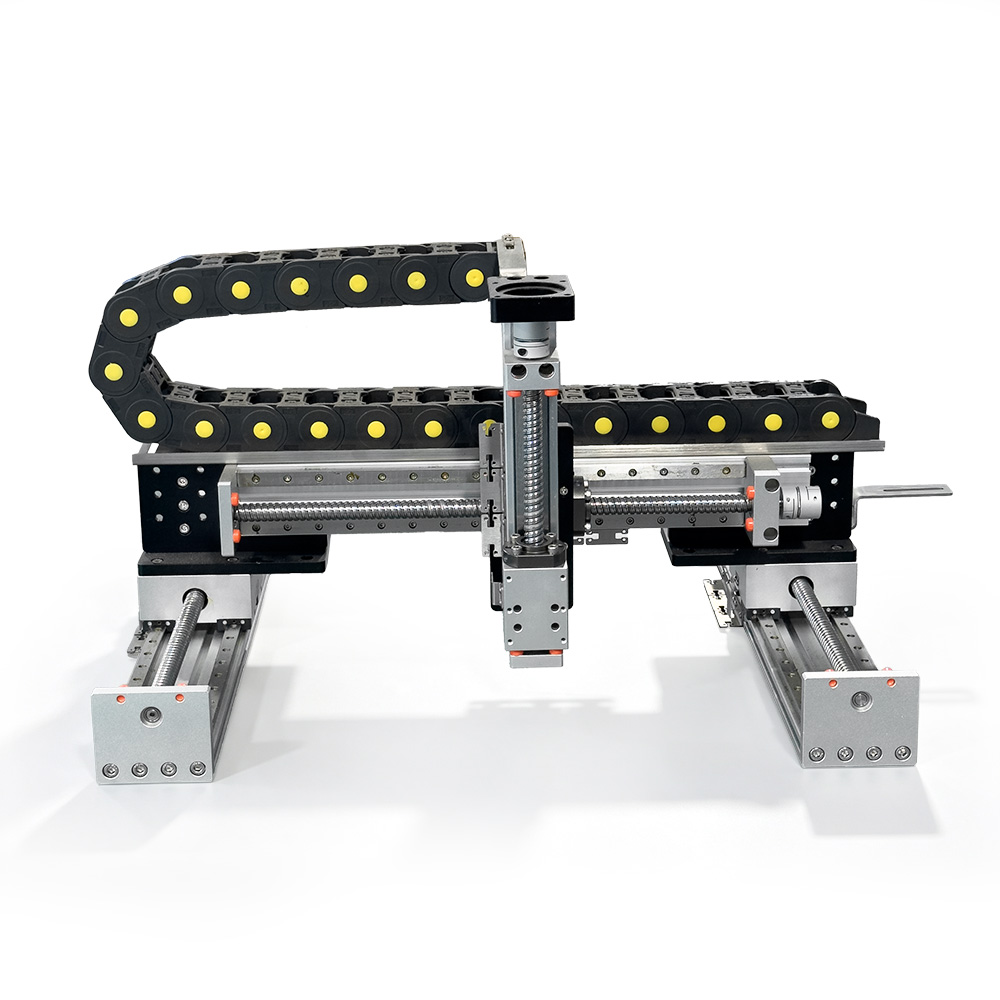
For OEM machine builders and automation integrators, custom Cartesian robots can be engineered according to specific requirements for stroke, payload, speed, positioning accuracy, working envelope, mounting configuration, and control system.
Cartesian robots are industrial automation systems that use two or more linear axes to move a tool or workpiece along Cartesian coordinates.
A typical XYZ Cartesian robot consists of:
The axes work together to create controlled movement along the X, Y, and Z directions.
For example:
X-axis → Left and right movement
Y-axis → Forward and backward movement
Z-axis → Up and down movement
This relatively straightforward structure makes Cartesian robots easy to configure for many industrial automation applications.
A Cartesian robot converts programmed motion commands into linear movement along one or more axes.
A typical operating process includes:
The motion of each axis can be independently controlled while the overall system coordinates the movement.
This makes Cartesian robots suitable for repetitive and highly structured production processes.
Standard Cartesian robots may not always fit specialized production equipment.
A custom Cartesian robot can be designed around the customer's actual application requirements.
Important customization parameters include:
This makes Cartesian automation especially suitable for OEM projects where standard catalog dimensions are not sufficient.
One of the biggest advantages of Cartesian robots is the ability to create a large rectangular working envelope.
By changing the length of the linear axes, manufacturers can adapt the robot to different production spaces.
For example:
This makes custom Cartesian robots useful for both compact equipment and large industrial automation systems.
Cartesian robots use linear motion components to guide movement along defined axes.
Depending on the selected linear modules, drive mechanisms, motors, and control system, the robot can be configured for demanding positioning applications.
Potential applications include:
The actual achievable accuracy should always be evaluated according to the complete mechanical and control system.
Cartesian robots can be designed with extended linear axes.
This is particularly useful for:
For long travel applications, engineers can select suitable belt-driven, ball screw, rack-and-pinion, or linear motor modules according to speed, load, and accuracy requirements.
Unlike multi-joint robotic arms, Cartesian robots primarily rely on linear movement.
This can make the system easier to understand and configure for applications involving:
The mechanical structure is also relatively straightforward, which can simplify machine integration and maintenance.
Pick and place is one of the most common applications for Cartesian robots.
A typical XYZ robot can perform:
Pick → Lift → Move → Lower → Release → Return
This configuration can be used for:
For high-cycle applications, the system can be configured with appropriate linear modules, servo motors, grippers, and controllers.
A custom Cartesian robot can automate repetitive assembly operations.
Possible applications include:
For multi-axis assembly systems, the X-Y-Z configuration allows the tool to reach specific positions within the machine workspace.
Cartesian automation can also be used to load and unload industrial machines.
For example:
Part Loading → CNC Processing → Part Unloading → Inspection
The robot can move components between machines and workstations while reducing manual handling.
This can improve production consistency and help manufacturers increase machine utilization.
Dispensing applications often require controlled movement along predefined paths.
A Cartesian robot can move a dispensing head along:
This allows manufacturers to automate:
The required motion accuracy, speed, and path control should be matched to the dispensing process.
Cartesian robots can position cameras, sensors, or products for automated inspection.
Applications include:
For inspection systems, repeatable positioning is particularly important because the camera or sensor must reach a consistent inspection position.
| Feature | Cartesian Robot | Articulated Robot |
|---|---|---|
| Motion | Linear axes | Rotary joints |
| Working Envelope | Usually rectangular | More flexible |
| Long Linear Travel | Excellent | More complex |
| Positioning | Highly predictable | Highly flexible |
| Structure | Relatively simple | More complex |
| Programming | Often straightforward | More complex |
| Customization | Excellent for linear layouts | Excellent for complex paths |
| Typical Applications | Pick & place, dispensing, assembly | Welding, handling, complex assembly |
The best choice depends on the production process.
If the application requires long linear movement and a structured working envelope, Cartesian robots can be highly effective. If the application requires complex orientation and movement around obstacles, an articulated robot may be more appropriate.
A custom Cartesian robot can be configured in different ways.
Usually uses:
X + Y
Suitable for:
Uses:
X + Y + Z
Suitable for:
A fourth axis can be added when rotational positioning is required.
This can provide greater flexibility for specialized automation applications.
The choice of linear drive mechanism directly affects robot performance.
A belt-driven linear module is often considered for:
A ball screw driven axis can be considered when the application emphasizes:
Suitable for certain long-travel applications requiring:
Linear motors can be considered for demanding applications requiring:
The optimal configuration depends on the actual payload, stroke, speed, accuracy, and duty cycle.
For OEM customers, the most important advantage of Cartesian automation is flexibility.
A custom system can be designed according to:
The X, Y, and Z travel distances can be selected according to the required working area.
The robot structure and drive system can be selected based on the combined weight of:
Axis speed can be configured according to the required cycle time.
The mechanical structure, linear guides, drive mechanism, motor, encoder, and controller can be selected according to positioning requirements.
The robot can be designed for:
Possible tooling includes:
When selecting a Cartesian robot manufacturer, OEM customers should consider both product specifications and engineering capabilities.
The supplier should be able to evaluate:
Look for a supplier that can customize:
A complete Cartesian automation system may need to communicate with:
A supplier with integration experience can simplify the overall automation project.
For a custom project, it is useful to provide the manufacturer with detailed technical requirements.
Recommended information includes:
This information allows the manufacturer to select the appropriate linear modules and develop a suitable Cartesian robot configuration.