Modern manufacturers increasingly need conveyor systems that can combine continuous material flow, precise positioning, compact layouts, and multi-station automation. For applications where a traditional straight conveyor cannot provide enough flexibility, an oval conveyor can offer a more efficient alternative.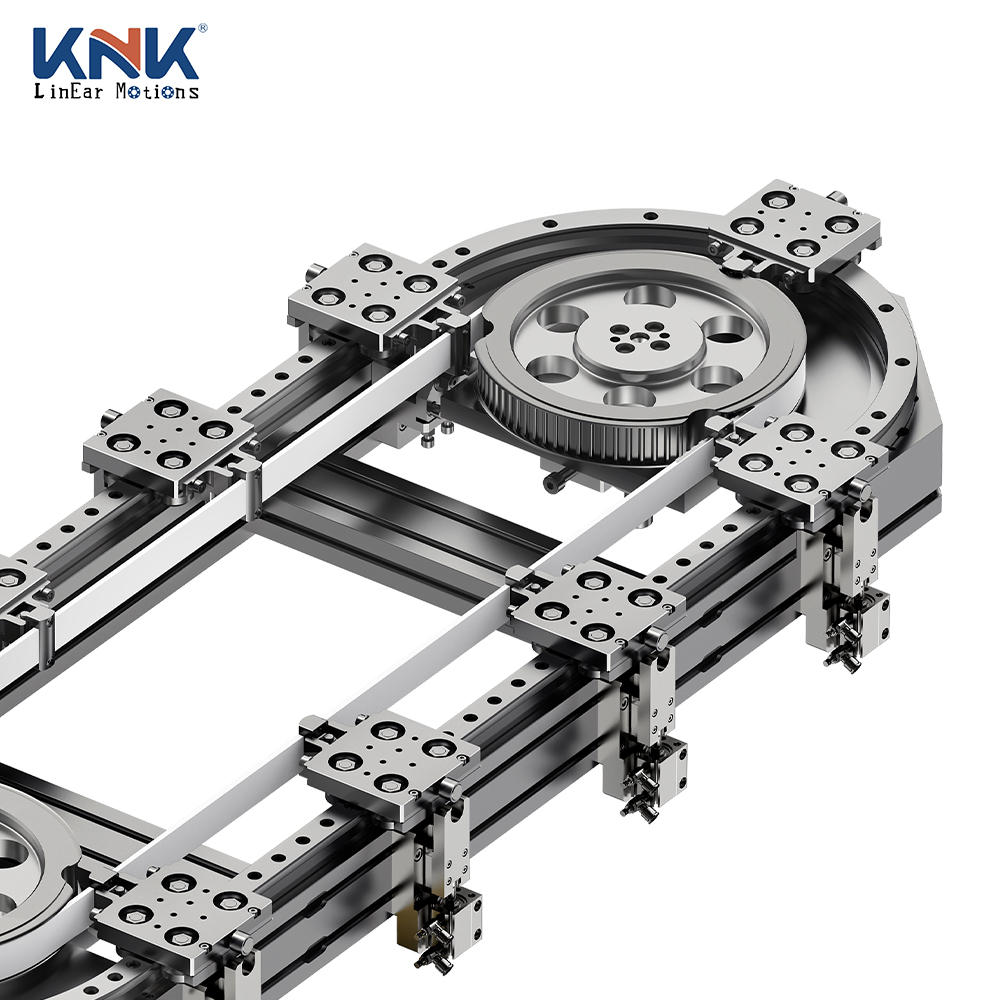
An Oval Conveyor System uses a closed-loop oval track to circulate products, pallets, or workpieces through multiple production stations. This configuration allows assembly, inspection, testing, dispensing, and other processes to be arranged around a continuous production loop.
For OEM machine builders and automation integrators, a custom oval conveyor can be configured around the product size, payload, cycle time, positioning accuracy, workstation layout, and automation equipment required for a specific application.
An oval conveyor is a closed-loop conveyor system with two curved sections connected by two straight sections. Products or pallets travel continuously around the oval track and can stop at designated workstations for automated processing.
Compared with conventional linear conveyors, an oval configuration provides greater flexibility for multi-station production.
A typical precision oval conveyor may include:
Depending on the application, the system can be designed for continuous transportation or precise indexing.
An oval conveyor moves products or pallets along a closed-loop track.
A typical production process is:
Multiple workstations can operate simultaneously, allowing manufacturers to achieve efficient production flow.
One major advantage of an oval conveyor system is that multiple processes can be arranged along a single closed-loop track.
For example:
Loading → Assembly → Inspection → Testing → Marking → Unloading
Different operations can take place at different stations while other products continue through the system.
This can improve:
The oval configuration gives engineers more freedom when designing production lines.
A custom oval conveyor can be adapted to:
This makes oval conveyors particularly useful for customized OEM automation projects.
A closed-loop design allows pallets to return automatically to the loading area after completing the production process.
This reduces the need for:
It also makes the production process easier to automate.
For precision manufacturing, simply transporting a product is not enough. The conveyor must also position it accurately at each workstation.
A precision oval conveyor can incorporate dedicated positioning mechanisms to achieve repeatable stopping and accurate workstation alignment.
This is useful for:
An oval conveyor can help organize several production stations within a relatively compact footprint.
Instead of building a very long linear production line, engineers can arrange workstations around the oval path.
This can improve:
| Feature | Oval Conveyor | Straight Conveyor |
|---|---|---|
| Conveyor Layout | Closed-loop | Linear |
| Multi-Station Production | Excellent | Good |
| Pallet Recirculation | Built-in | Usually requires return system |
| Layout Flexibility | High | Moderate |
| Space Utilization | Excellent for looped processes | Depends on line length |
| Automated Indexing | Available | Available |
| Customization | High | High |
For production lines requiring pallet circulation and multiple processing stations, an oval conveyor system can provide a more streamlined solution.
An important application of oval conveyors is automated assembly.
A precision system can transport individual workpiece carriers through several automated stations, such as:
The conveyor provides a consistent transportation path while automation equipment performs the actual manufacturing operations.
An oval conveyor can also be integrated with automated inspection systems.
For example:
Load → Assembly → Vision Inspection → Functional Test → Final Inspection → Unload
Machine vision cameras can inspect products at specific stations, while sensors and testing equipment evaluate product performance.
Accurate pallet positioning is particularly important because the camera or testing equipment needs a stable and repeatable target position.
A custom oval conveyor system can be integrated with different types of automation equipment.
Possible integrations include:
For example, a robot can pick components from one station, place them onto a product, and then allow the pallet to continue to the next station automatically.
This makes the oval conveyor a useful foundation for highly automated production cells.
Standard conveyors may not always fit specialized production requirements.
A custom oval conveyor can be designed around the customer's actual application.
The overall length, width, radius, and track configuration can be adjusted according to available installation space.
The conveyor structure and drive system can be selected according to the weight of:
For precision assembly and inspection, the positioning system can be configured according to required repeatability.
The conveyor can be designed around:
Pallets can be designed according to the shape and dimensions of the workpiece.
This is particularly useful for OEM applications involving non-standard products.
Choosing an oval conveyor system manufacturer should involve more than comparing the conveyor's basic dimensions and price.
OEM customers should evaluate several factors.
The supplier should understand:
Look for manufacturers capable of developing:
Precision machining and accurate assembly directly influence conveyor performance.
The manufacturer should be able to consider integration with:
Oval conveyors are suitable for many industrial applications, including:
The exact conveyor configuration should be selected according to the product, process, payload, and required cycle time.
Although both are closed-loop conveyor solutions, they are not exactly the same.
| Feature | Oval Conveyor | Circular Conveyor |
|---|---|---|
| Straight Sections | Yes | No |
| Curved Sections | Two ends | Continuous curve |
| Layout | Long and narrow | More compact/round |
| Suitable for Long Workstations | Excellent | Moderate |
| Production Flow | Continuous loop | Continuous loop |
| Customization | High | High |
An oval conveyor can be particularly useful when the production line needs a longer working area while maintaining a closed-loop pallet circulation system.
A custom solution can be optimized for the entire production process rather than simply transporting products from Point A to Point B.
Engineers can coordinate:
Conveyor + Pallet + Positioning + Robot + Inspection + Assembly + Control
This integrated approach can help reduce unnecessary transfers and improve the overall efficiency of an automated production line.
For OEM customers, customization is particularly valuable when the production process involves non-standard product dimensions, special payload requirements, precise positioning, or complex workstation layouts.