Modern automated production lines often need to handle products with different spacing requirements. A fixed-pitch transfer system may work well for standardized products, but it can become restrictive when production processes require different distances between workpieces.
A Variable Pitch Module Customized solution provides a flexible way to adjust the spacing between multiple products, tools, or workpieces during automated handling and processing.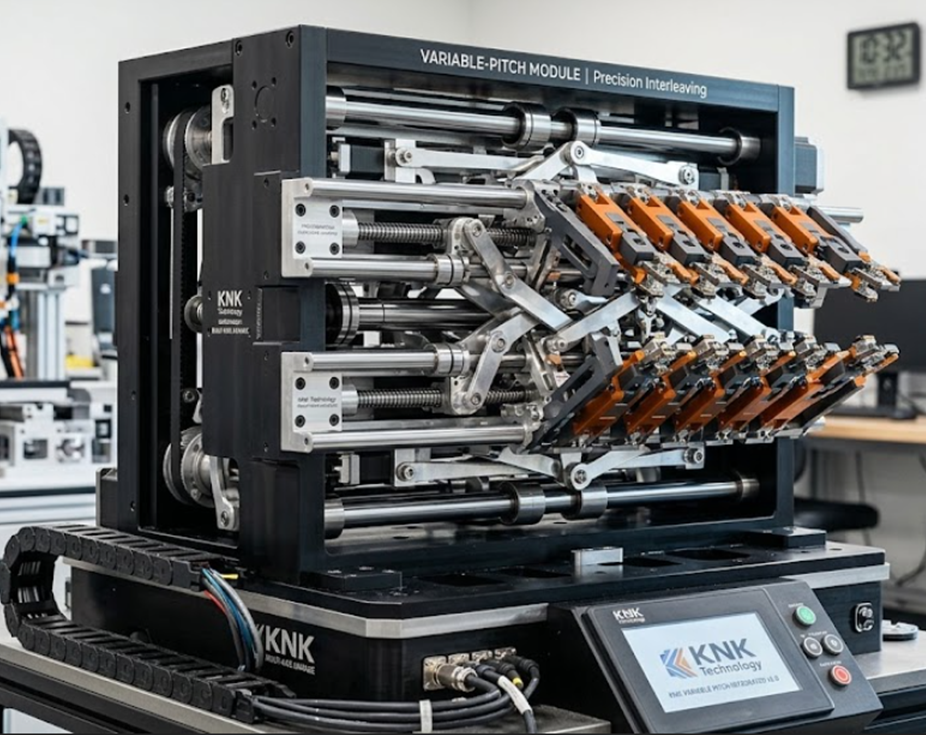
By integrating multiple moving elements into one coordinated motion system, a customized variable pitch module can help manufacturers improve production flexibility, optimize workstation spacing, and simplify automated transfer processes.
For OEM machine builders and automation integrators, the key advantage is that the module can be designed around the actual application, including pitch range, number of carriers, stroke, payload, speed, accuracy, and installation dimensions.
A variable pitch module is a motion mechanism designed to change the distance between multiple moving units.
Unlike a conventional linear module with a single fixed carriage, a variable pitch system can control several carriers or tooling points and adjust their relative spacing.
For example, a production process may require:
Initial pitch → Transfer → Expansion → Processing → Contraction → Output
The module can automatically adjust the spacing according to the requirements of different production stages.
This makes variable pitch technology particularly useful for automated assembly, packaging, inspection, sorting, and material handling.
The working principle depends on the mechanical design, but a typical system uses coordinated motion to change the distance between multiple moving elements.
A simplified process is:
This allows one motion system to perform both transportation and spacing adjustment.
Standard variable pitch systems may not match every production requirement.
A customized variable pitch module can be designed around the actual machine layout and process requirements.
Key customization parameters include:
This makes customized variable pitch systems suitable for specialized OEM automation projects.
The biggest advantage is the ability to change the distance between products or workpieces.
For example:
20 mm pitch → 50 mm pitch → 100 mm pitch
The actual pitch range depends on the mechanical structure and application requirements.
This flexibility can help one production line handle different processes without requiring separate transfer mechanisms.
A variable pitch system can coordinate multiple products simultaneously.
Instead of adjusting each workpiece independently, the module can change the spacing of several workpieces as part of one automated motion sequence.
Potential benefits include:
Different production stations may require different product spacing.
For example:
Feeding → Inspection → Assembly → Testing → Packaging
The required pitch at each station may not be identical.
A customized variable pitch module can help bridge these differences automatically.
A variable pitch mechanism can compress products when space is limited and expand them when more working space is required.
This can help optimize:
One of the most useful applications is automated assembly.
Consider a system in which several components need to be assembled simultaneously.
At the feeding station, products may be close together. Before entering the assembly station, the module can increase the pitch to provide enough space for:
After assembly, the pitch can be reduced again for downstream transportation.
This makes the variable pitch module an effective motion solution for multi-product automation.
Variable pitch technology can also improve automated pick and place processes.
A typical process could be:
Feed → Separate → Pick → Place → Reposition
Products can be moved from a compact feeding arrangement into a larger spacing configuration that matches the working positions of multiple grippers.
This can be particularly useful when one robot or pick-and-place system needs to handle several products simultaneously.
Vision inspection equipment often requires sufficient spacing between products to prevent overlapping images.
A customized variable pitch module can separate products before they reach the inspection station.
This allows cameras to inspect each item individually.
Applications include:
Accurate pitch control can improve the stability of automated inspection processes.
Packaging machinery frequently needs to change product spacing before products enter different processing stations.
A variable pitch system can help with:
This can improve synchronization between upstream conveyors and downstream packaging equipment.
A customized module can be designed for different pitch requirements.
Products remain at a consistent distance from each other.
For example:
50 mm → 50 mm → 50 mm → 50 mm
This is suitable for synchronized multi-station processing.
The distance between products can change during movement.
For example:
30 mm → 60 mm → 100 mm → 60 mm
This is useful when different production stations require different spacing.
For OEM automation, the appropriate configuration should be determined based on the complete process.
For OEM customers, customization can go far beyond simply changing the pitch.
The manufacturer can design the mechanism around the required minimum and maximum spacing.
The system can be configured for different numbers of products or workpieces.
The movement distance can be customized according to the required pitch adjustment.
The system should be designed based on the total moving load, including:
The required cycle time determines the appropriate motion speed and acceleration.
For precision assembly and inspection, the system may require accurate and repeatable positioning.
The overall length, width, and height can be adapted to the available machine space.
Different mechanical configurations can be considered depending on application requirements.
Suitable for applications requiring:
Suitable when the application emphasizes:
Suitable for applications requiring synchronized and repetitive pitch changes.
Servo motors can provide flexible electronic control of movement and pitch adjustment.
The appropriate drive technology should be selected based on speed, accuracy, payload, cycle time, and duty cycle.
When selecting a variable pitch module manufacturer, OEM customers should evaluate more than the catalog specifications.
The supplier should understand:
Look for suppliers capable of providing:
A reliable supplier should be able to test:
| Feature | Variable Pitch Module | Conventional Conveyor |
|---|---|---|
| Product Spacing | Adjustable | Usually Fixed |
| Multi-Product Control | Excellent | Limited |
| Pitch Adjustment | Yes | Usually No |
| Precision Positioning | High | Application dependent |
| Multi-Station Automation | Excellent | Good |
| Customization | High | Moderate to High |
A conventional conveyor is primarily designed to transport products. A variable pitch module provides an additional motion function by actively controlling the spacing between products.
Variable pitch systems can be used in:
Before requesting a quotation, OEM customers should prepare several key parameters:
The more complete the application information, the easier it is for the manufacturer to develop the appropriate customized design.