In modern industrial automation, manufacturers are constantly looking for ways to improve efficiency, precision, and layout flexibility. One solution that has gained increasing popularity is the circular guide rail system (also called a circular conveyor or ring track system). But what exactly is a circular guide rail, and how does it differ from traditional conveyor lines?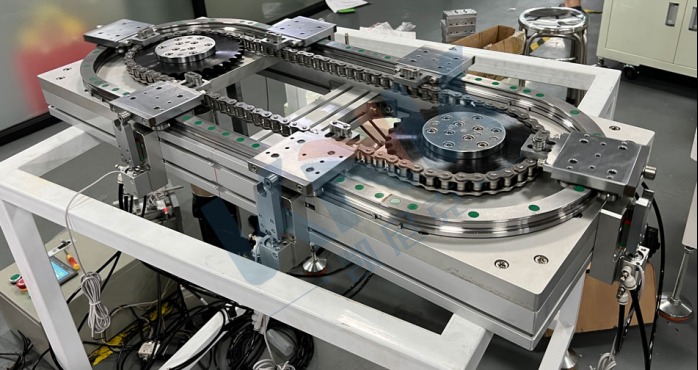
This article explains the working principle, key advantages, and application differences to help you choose the right solution for your production line.
A circular guide rail is a closed-loop linear motion system formed into a circular or oval shape. It consists of precision guide rails, carriages, and a synchronized drive system such as belt drive, chain drive, or cam-driven indexing.
Workstations are arranged around the loop, allowing products to circulate continuously or index precisely from station to station. Compared with straight linear conveyors, circular guide rails are designed for high-precision positioning, compact layouts, and multi-station automation.
Typical components include:
Precision hardened guide rails
Rolling carriages with low friction
Synchronous belt, chain, or cam drive
Servo motor or stepper motor control
Optional positioning and clamping mechanisms
Traditional conveyor lines usually refer to belt conveyors, roller conveyors, or chain conveyors used to transport products from point A to point B in a straight or slightly curved path.
Their main purpose is material handling, not precision positioning. They are widely used in packaging, warehousing, logistics, and simple assembly lines where high accuracy is not required.
Common features of traditional conveyors:
Simple mechanical structure
Continuous movement
Low positioning accuracy
Mainly for product transportation, not processing
Circular guide rail systems are designed for precise positioning, often achieving repeatability of ±0.05 mm or better. This makes them ideal for operations such as:
Pick and place
Screw fastening
Inspection
Dispensing
Press fitting
Traditional conveyors typically have positioning accuracy around several millimeters, which is not suitable for precision assembly tasks.
A circular or oval guide rail forms a closed loop, allowing multiple workstations to be arranged around the track. This creates a compact and highly efficient production cell.
Traditional conveyor lines usually require longer straight paths, occupying more floor space and limiting flexible workstation placement.
Circular guide rail systems are often used as the core platform of automated assembly machines, integrating:
Robots
Vision systems
Press units
Testing stations
They support both continuous flow and indexed motion, enabling synchronized multi-step processing.
Traditional conveyors mainly focus on transportation and require additional fixtures or stop mechanisms to perform processing tasks.
Due to rigid guide rails and precision carriages, circular guide rail systems can handle higher loads with stable motion, making them suitable for heavier products and tooling integration.
Traditional belt conveyors may suffer from belt deformation, slipping, and vibration when carrying heavy loads.
Circular guide rail systems can be customized in:
Track diameter or oval length
Number of stations
Drive type
Payload capacity
They are easy to expand or reconfigure for different production needs.
Traditional conveyors are less flexible once installed and usually require major modifications to change layouts.
Circular guide rails are widely used in industries that require high efficiency and high precision, such as:
Electronics assembly lines
Automotive parts production
Medical device manufacturing
Battery module assembly
Cosmetic and pharmaceutical packaging
They are especially suitable for multi-station automatic assembly and inspection systems.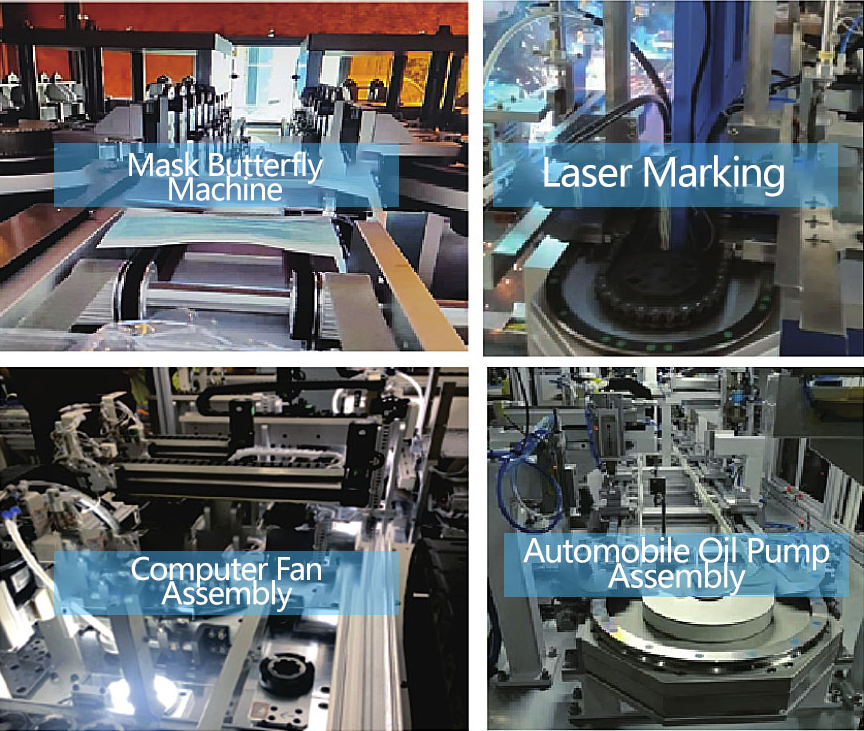
You should consider a circular guide rail system if:
You need high positioning accuracy
Your process involves multiple precise operations
Factory space is limited
You want to integrate robots or vision systems
You need synchronized and stable motion control
If your main goal is only to transport products over long distances without precision requirements, a traditional conveyor line is usually more cost-effective.
While traditional conveyor lines are ideal for simple material transport, circular guide rail systems provide a powerful solution for precision automation and multi-station assembly. With higher positioning accuracy, compact layouts, and strong integration capabilities, circular guide rails play a key role in modern intelligent manufacturing.
Choosing the right conveying and positioning system can significantly improve production efficiency, product quality, and overall automation level.
If you are planning an automated assembly or testing line, a circular guide rail system may be the best foundation for your solution.