In modern industrial automation and mechanical systems, linear actuators play a critical role in lifting, pushing, pressing, and positioning loads. Among them, electric cylinders and hydraulic cylinders are two of the most widely used solutions. Although both serve similar functions, their working principles, performance characteristics, and application scenarios are significantly different.
What Is an Electric Cylinder?
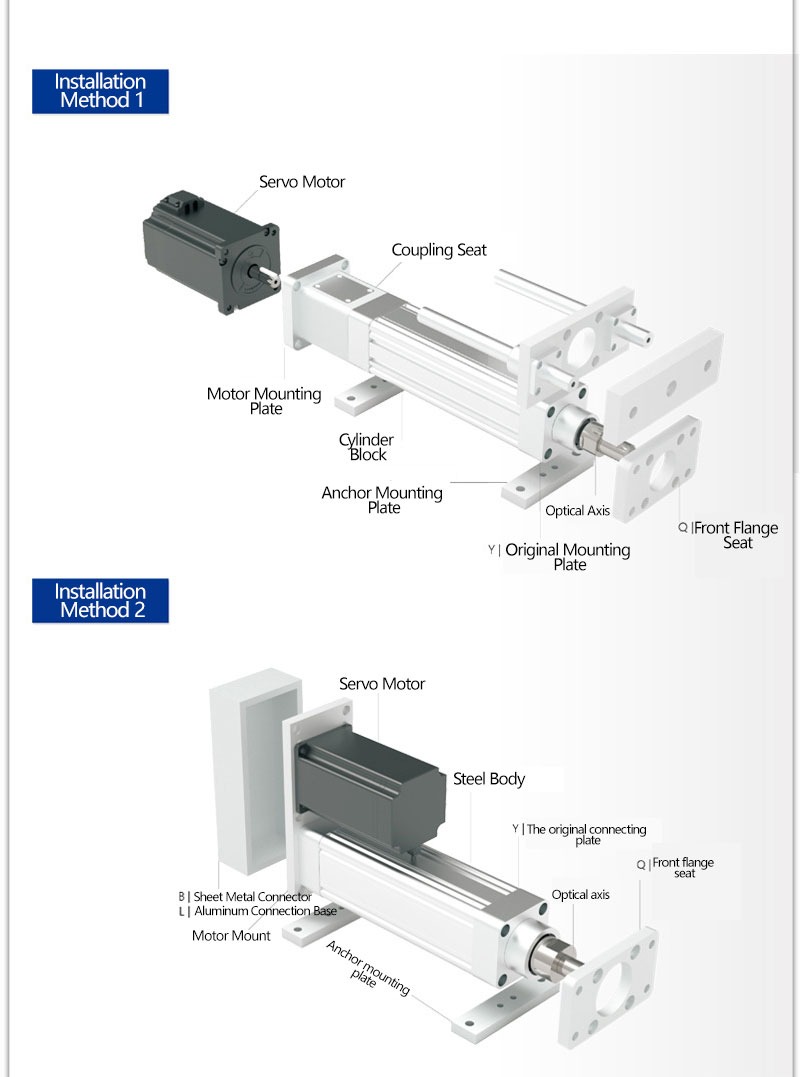
An electric cylinder (also called an electric linear actuator) converts electric motor rotation into linear motion through mechanisms such as a ball screw or roller screw. It is typically driven by a servo motor or stepper motor and controlled by a servo drive.
Electric cylinders are widely used in automation equipment, robotics, packaging machines, medical devices, and precision assembly systems.
What Is a Hydraulic Cylinder?
A hydraulic cylinder generates linear motion using hydraulic oil pressure supplied by a hydraulic power unit (HPU). It relies on fluid force to push the piston rod and is commonly used in heavy-duty industrial equipment, such as construction machinery, metal forming presses, and large lifting systems.
Key Differences Between Electric Cylinders and Hydraulic Cylinders
| Aspect |
Electric Cylinder |
Hydraulic Cylinder |
| Power Source |
Electric motor |
Hydraulic oil pressure |
| Control Accuracy |
Very high (±0.01 mm achievable) |
Moderate |
| Cleanliness |
Clean, no oil leakage |
Risk of oil leakage |
| Noise Level |
Low |
High (pump and valves) |
| Installation |
Compact, easy |
Complex hydraulic system |
| Maintenance |
Low |
High |
| Energy Efficiency |
High |
Lower |
| Maximum Force |
Medium to high |
Very high |
Advantages of Electric Cylinders
1. High Precision and Repeatability
Electric cylinders offer excellent positioning accuracy, making them ideal for applications requiring precise motion control, such as pick-and-place systems, electronic assembly, and automated inspection.
2. Energy Efficiency
Electric actuators consume energy only when moving, unlike hydraulic systems that require continuous pump operation. This leads to lower long-term operating costs.
3. Clean and Environmentally Friendly
Without hydraulic oil, electric cylinders eliminate the risk of leakage, contamination, and environmental pollution, making them suitable for food, pharmaceutical, and cleanroom environments.
4. Easy Integration and Smart Control
Electric cylinders can be easily integrated with PLC, servo drives, and industrial networks, enabling real-time monitoring, position feedback, and intelligent motion control.
Disadvantages of Electric Cylinders
• Limited force capacity compared to large hydraulic cylinders
• Higher initial cost in high-load applications
• Performance may decrease in extreme temperatures or harsh environments
Advantages of Hydraulic Cylinders
1. Extremely High Output Force
Hydraulic cylinders can generate very large thrust forces, making them irreplaceable in heavy-duty applications such as forging presses, injection molding machines, and lifting equipment.
2. Strong Overload Resistance
Hydraulic systems can handle shock loads and continuous heavy operation better than electric cylinders.
3. Reliable in Harsh Conditions
They perform well in high-temperature, dusty, or outdoor environments where electric components may degrade faster.
Disadvantages of Hydraulic Cylinders
• Oil leakage risk and environmental concerns
• High maintenance cost (seals, oil, pumps, valves)
• Lower positioning accuracy
• Complex system installation and higher noise levels
Electric Cylinder vs Hydraulic Cylinder: Which One Should You Choose?
Choose an electric cylinder if your application requires:
• High positioning accuracy
• Clean and quiet operation
• Easy automation and digital control
• Lower long-term maintenance cost
Choose a hydraulic cylinder if your application requires:
• Extremely high force output
• Heavy-duty or continuous operation
• High shock resistance
• Operation in harsh environments
Conclusion
Both electric cylinders and hydraulic cylinders have their own strengths and limitations. With the rapid development of industrial automation and smart manufacturing, electric cylinders are increasingly replacing hydraulic systems in many applications. However, hydraulic cylinders remain indispensable in high-force and heavy-load scenarios.
Understanding the differences between electric cylinders vs hydraulic cylinders allows you to make a smarter, more cost-effective choice for your machinery and automation projects.