A direct drive linear motor is a linear motion technology that generates linear movement directly through electromagnetic force, without requiring a conventional mechanical transmission such as a belt, ball screw, or gear rack.
By reducing the number of mechanical transmission components between the motor and moving load, direct drive linear motors can provide high dynamic response, high-speed movement, precise positioning, and smooth motion. These characteristics make them attractive for demanding automation applications where conventional mechanical drive systems may not provide the required combination of speed and motion performance.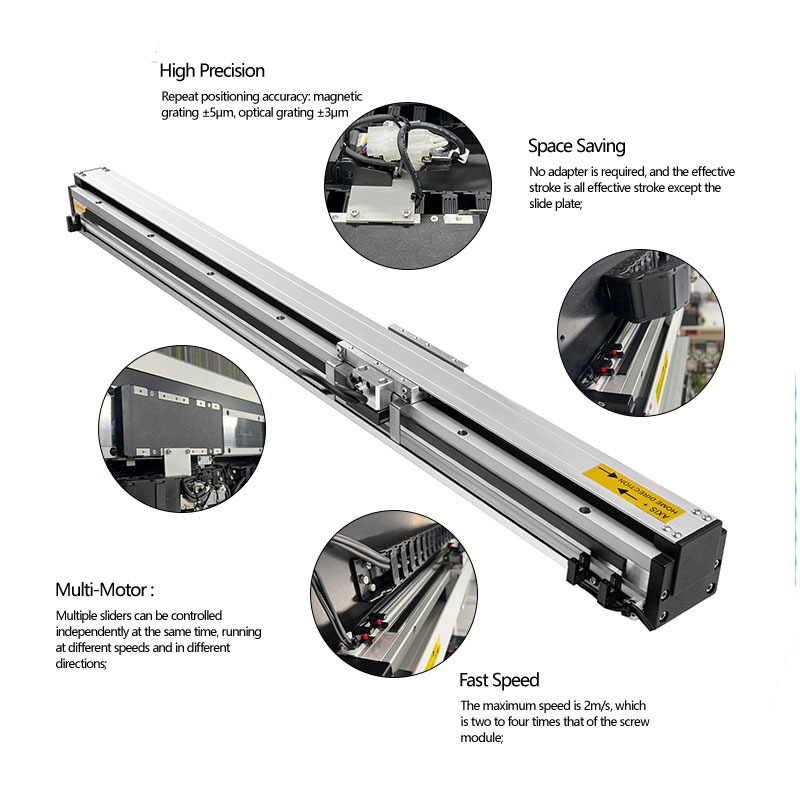
For OEM equipment manufacturers, however, selecting a direct drive linear motor is not simply about choosing the highest speed or acceleration. The motor, guide system, encoder, controller, load, stroke, and mechanical structure need to be designed as an integrated motion system.
A direct drive linear motor converts electrical energy directly into linear motion.
Unlike a traditional rotary motor combined with a screw, belt, or rack-and-pinion mechanism, a linear motor produces linear force without requiring a mechanical rotary-to-linear transmission.
A typical direct drive linear motor system may include:
The exact configuration depends on the application.
For custom automation, the linear motor should be selected together with the guide and feedback system to meet the required stroke, force, speed, acceleration, and positioning performance.
The biggest difference between a direct drive linear motor and a conventional linear actuator is the absence of a mechanical transmission between the motor and load.
Traditional systems may use:
Rotary Motor → Gear/Belt/Screw → Linear Movement
A direct drive linear motor uses:
Electrical Energy → Electromagnetic Force → Linear Movement
This simplified transmission path can reduce mechanical transmission elements and provide a highly responsive motion system.
Direct drive linear motors are well suited to applications requiring high linear speed.
Because there is no conventional screw or belt transmission limiting the movement, the motor can be designed for high-speed dynamic motion.
Potential applications include:
Actual maximum speed depends on the motor design, load, stroke, cooling, guide system, encoder, and servo drive.
Direct drive technology can provide rapid changes in speed and direction.
This can be particularly valuable in machines with frequent:
For high-cycle automation, the complete mechanical system should be evaluated to ensure that the guide, structure, payload, and controller can support the required dynamic performance.
A direct drive linear motor can be combined with a linear encoder to provide closed-loop position feedback.
The encoder continuously provides position information to the servo control system, allowing the controller to regulate the motor according to the required position.
This makes direct drive linear motors suitable for:
The actual positioning accuracy and repeatability depend on the complete system, including the encoder resolution, mechanical structure, guide accuracy, thermal conditions, controller, and installation.
Because direct drive systems do not require conventional mechanical transmission components such as gearboxes or screws, they can provide smooth linear motion.
This can be useful for applications where vibration or mechanical transmission effects may influence the final process.
Typical applications include:
A conventional linear motion system may contain components such as:
A direct drive linear motor removes many of these transmission components.
This can reduce certain types of mechanical wear and maintenance associated with mechanical transmission systems.
However, the linear guide, bearings, encoder, and other components still require appropriate maintenance depending on the application and environment.
Direct drive linear motors can be configured for different stroke requirements.
For custom OEM projects, engineers can consider:
Multiple linear motors can also be combined to create XY or XYZ positioning systems.
The selection between a direct drive linear motor and a conventional mechanical linear drive depends on the application.
| Feature | Direct Drive Linear Motor | Belt Drive | Ball Screw | Gear Rack |
|---|---|---|---|---|
| Direct linear drive | Yes | No | No | No |
| High-speed motion | Excellent | Excellent | Moderate | Good |
| Dynamic response | Excellent | Good | Moderate | Good |
| Mechanical transmission | Minimal | Yes | Yes | Yes |
| Long stroke | Suitable | Suitable | Application dependent | Suitable |
| Precision positioning | Excellent potential | Good | Excellent potential | Good |
| Maintenance of transmission | Low | Belt-related | Screw-related | Gear-related |
| Customization | High | High | High | High |
This does not mean that a linear motor is always the best solution. For many industrial applications, belt, ball screw, or gear rack systems can provide a more economical solution.
A direct drive linear motor is particularly attractive when high speed, high acceleration, smooth movement, and precise positioning are important.
Semiconductor manufacturing and inspection equipment can require highly controlled linear movement.
Direct drive linear motors can be used for:
The motion system must be designed around the required positioning performance and environmental conditions.
High-speed inspection systems may need to move cameras, sensors, or products rapidly and repeatedly.
A direct drive linear motor can provide the controlled movement required for:
The high dynamic response of a linear motor can be useful when inspection speed is closely related to production throughput.
Electronic components often require high-speed and repeatable handling.
Direct drive linear motor stages can be integrated into:
For these applications, the motor can be combined with a linear encoder and precision guide system.
In precision assembly machines, the actuator must move components to predefined positions while maintaining consistent motion.
Direct drive linear motors can be used for:
The appropriate motor force and feedback system should be selected according to the actual assembly process.
Direct drive linear motors can also be used in high-speed pick-and-place systems.
The combination of high acceleration and precise positioning can support rapid movement between pickup and placement positions.
A typical system may combine:
Linear Motor + Linear Guide + Encoder + Servo Drive + Gripper
The final performance depends on the entire system rather than the linear motor alone.
Some laboratory automation and medical equipment require smooth and controlled linear positioning.
Potential applications include:
The motor configuration can be customized according to the available space, stroke, payload, and required motion profile.
Direct drive linear motors can also be integrated into specialized production machinery where high dynamic performance is required.
Examples include:
For OEM customers, a direct drive linear motor should be designed according to the complete application rather than selected only from a catalog.
Important design parameters include:
Stroke → Load → Force → Speed → Acceleration → Positioning → Duty Cycle → Encoder → Guide → Cooling → Controller
For example, a customer may require a high-speed linear motor with a long stroke and low moving mass. Another application may prioritize positioning accuracy and thermal stability over maximum speed.
These two systems may require very different linear motor configurations.
A custom direct drive linear motor system can be configured according to:
This makes direct drive linear motor technology suitable for OEM automation equipment, precision machinery, robotics, inspection systems, semiconductor equipment, and custom production lines.
Before selecting a direct drive linear motor, OEM engineers should define the following:
Determine the total travel distance and whether the motor needs to operate continuously over the full stroke.
Calculate the complete moving mass, including tooling, workpiece, cable carrier, and other moving components.
The required force depends on acceleration, friction, gravity, external resistance, and other factors.
Determine the required operating speed and whether the application requires rapid acceleration and deceleration.
Define positioning accuracy and repeatability according to the actual process.
High-cycle applications require consideration of continuous force, peak force, thermal performance, and cooling.
A suitable linear encoder may be required for closed-loop positioning.
Temperature, dust, humidity, vibration, and other environmental factors can influence system design.
A direct drive linear motor is only one part of a complete linear motion system.
For OEM applications, the motor must work together with:
Linear Motor + Guide + Encoder + Servo Drive + Controller + Mechanical Structure
A custom linear motor manufacturer can evaluate these components together and develop a motion configuration based on the customer's machine requirements.
This is particularly important for applications requiring non-standard stroke, high-speed movement, customized mounting dimensions, multiple axes, or special environmental conditions.
For KNK-type custom automation projects, the direct drive linear motor can also be considered as part of a broader linear motion module or multi-axis automation system.