As modern manufacturing continues to evolve toward intelligent automation, companies are looking for conveyor systems that offer more than simple product transportation. A Circular Conveyor Line combines continuous pallet circulation, precise indexing, and flexible workstation layouts, making it an ideal solution for high-speed automated production.
Unlike traditional straight belt conveyors, a Circular Conveyor Line enables products to move continuously through multiple processing stations within a compact footprint. This makes it particularly suitable for OEM machine builders, automation integrators, and manufacturers seeking customized production solutions.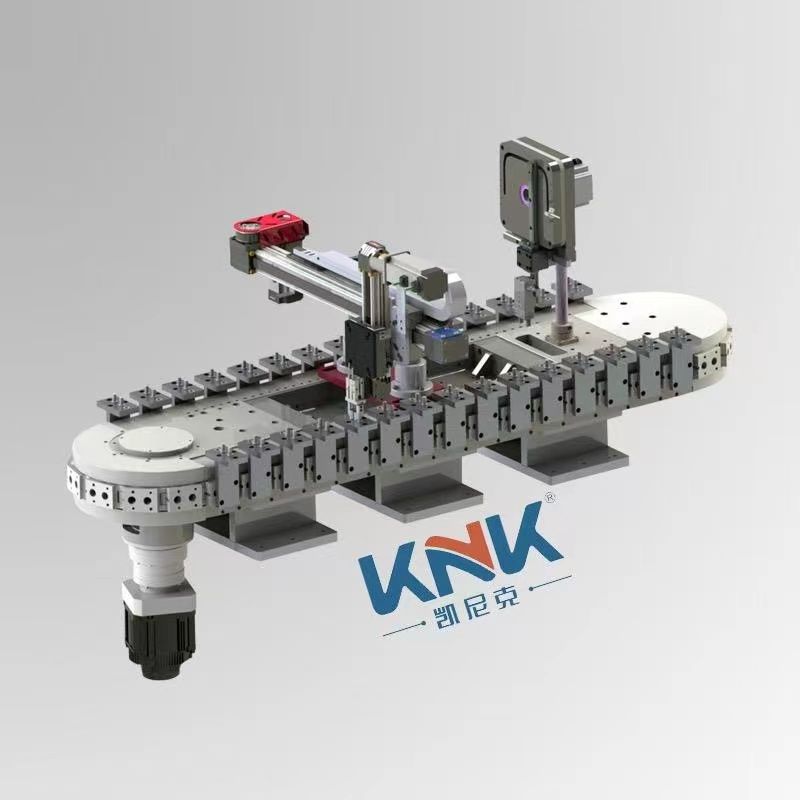
Whether used for electronics assembly, automotive components, medical devices, or packaging automation, a custom Circular Conveyor Line helps improve productivity, reduce manual labor, and ensure consistent product quality.
A Circular Conveyor Line is a closed-loop conveyor system that transports pallets or workpieces around a circular or oval track. Driven by a servo-controlled indexing mechanism, each pallet stops accurately at predefined workstations, allowing automated processes to be completed efficiently.
Compared with conventional conveyor systems, a circular conveyor line offers:
Its modular design also makes future expansion easier as production requirements change.
A Circular Conveyor Line typically consists of:
During operation, pallets move automatically between stations while the servo system ensures accurate stopping at each process location.
A typical production sequence includes:
This synchronized workflow maximizes efficiency and minimizes production interruptions.
Precision indexing allows every pallet to stop at the exact required location.
Benefits include:
High repeatability reduces manufacturing errors and scrap rates.
Because pallets circulate continuously, multiple workstations can operate simultaneously.
Advantages include:
This makes Circular Conveyor Lines ideal for high-volume manufacturing.
Compared with long straight conveyors, a circular layout maximizes production within a limited floor space.
Manufacturers benefit from:
A Circular Conveyor Line can easily integrate with:
This supports fully automated smart factories.
High-quality circular conveyor systems use:
These components ensure reliable long-term operation while reducing maintenance requirements.
Typical applications include:
Accurate positioning ensures consistent product quality.
Used for:
Servo indexing improves process reliability.
Suitable for:
Repeatable positioning supports strict quality standards.
Battery manufacturing benefits from:
Ideal for assembling:
Automation improves both productivity and consistency.
| Feature | Circular Conveyor Line | Traditional Belt Conveyor |
|---|---|---|
| Positioning Accuracy | Excellent | Moderate |
| Continuous Indexing | Yes | Limited |
| Automation Integration | Excellent | Basic |
| Space Utilization | High | Moderate |
| Multi-Station Production | Excellent | Limited |
| Production Flexibility | High | Moderate |
For precision assembly and intelligent manufacturing, Circular Conveyor Lines offer significantly better performance.
Every production process has unique technical requirements.
Custom Circular Conveyor Lines can be designed according to:
Optimized for available factory space.
Configured to match production processes.
Customized for specific product dimensions.
Designed for lightweight or heavy-duty applications.
Matched to required cycle times.
Compatible with robots, vision systems, PLCs, MES platforms, and Industry 4.0 solutions.
Customization ensures maximum productivity while supporting future expansion.
Before choosing a conveyor system, engineers should evaluate:
Determine pallet size and fixture requirements.
Influences structural design and drive selection.
Determines indexing and guide rail specifications.
Affects cycle time and station quantity.
Defines conveyor diameter and workstation arrangement.
Choose a modular system that supports additional stations and automation upgrades.
Working with an experienced manufacturer ensures the solution is tailored to your application.
Modern Circular Conveyor Lines are becoming smarter through technologies such as:
These innovations improve equipment utilization while reducing downtime.
An experienced manufacturer offers complete engineering services, including:
Professional engineering ensures reliable system performance and shorter project implementation times.