Precision link conveyor systems are industrial conveying solutions designed to transport workpieces, fixtures, or pallets between different processing and assembly stations with controlled movement and positioning.
Unlike conventional material handling conveyors that mainly focus on continuous transportation, precision link conveyor systems are often designed for automated manufacturing processes that require consistent workpiece transfer, accurate station positioning, and coordinated production operations.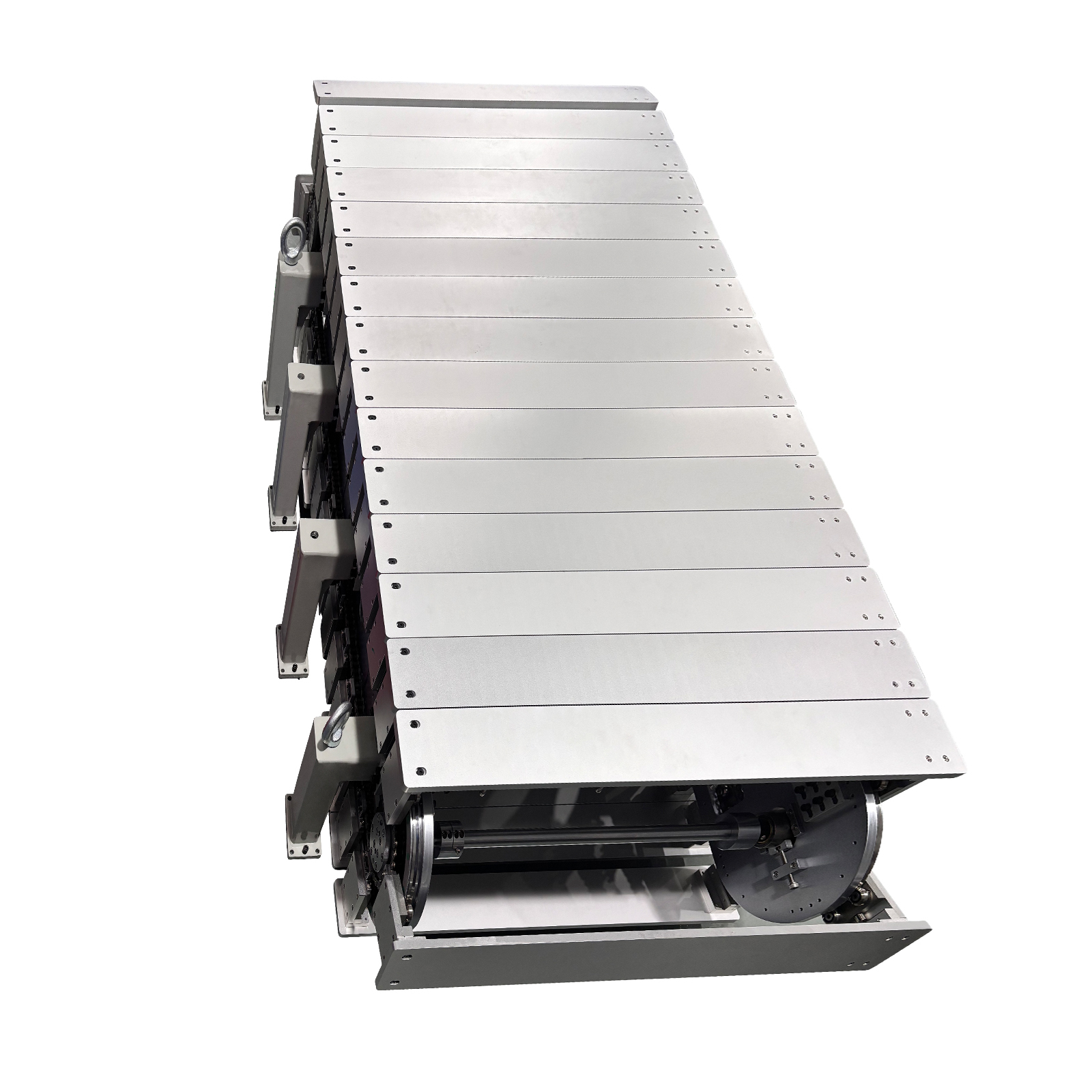
A typical precision link conveyor system consists of a precision conveyor chain, guide rails, drive mechanism, supporting structure, workpiece carriers, and control components.
Depending on the production requirements, the system may also integrate positioning units, sensors, lifting mechanisms, and automatic loading and unloading equipment.
Precision link conveyor systems are commonly used for:
Automated assembly lines.
Multi-station manufacturing processes.
Precision component handling.
Workpiece transfer between processing stations.
Automated inspection and testing equipment.
Repetitive production and indexing operations.
For OEM equipment manufacturers, choosing the right precision link conveyor system helps improve production organization, equipment integration, and manufacturing consistency.
The working principle of a precision link conveyor system is based on the movement of a chain or linked conveying mechanism that carries workpieces through a predefined production path.
The conveyor chain is driven by a motor and transmission mechanism. Workpieces are typically mounted on pallets, fixtures, or dedicated carriers attached to the conveying system.
The basic operating process includes the following steps.
Products or components are placed onto conveyor pallets or dedicated fixtures.
The loading process can be performed manually or integrated with automatic feeding and pick and place equipment.
The motor drives the sprocket or transmission mechanism, causing the precision conveyor chain to move along the designed track.
The chain transports the workpieces from one production position to another.
The pallets or fixtures move with the conveyor chain, carrying the workpieces through different processing stations.
The conveying path can be designed according to the machine layout and production requirements.
When a workpiece reaches a designated workstation, the system can use mechanical positioning devices, sensors, or indexing mechanisms to establish the required processing position.
For applications requiring higher positioning accuracy, a secondary positioning mechanism may be integrated into the conveyor system.
The workpiece is processed, assembled, tested, or inspected at the corresponding station.
Different operations can be performed at multiple stations along the production line.
After processing, the conveyor transports the workpiece to the next station.
Depending on the system design, the conveyor can operate continuously or through an intermittent indexing sequence.
Different manufacturing applications require different conveyor structures and movement configurations.
The following are common types used in industrial automation.
Straight precision link conveyor systems transport workpieces along a linear path.
They are commonly used in production lines where workstations are arranged in a straight layout.
Key characteristics include:
Simple conveying path.
Convenient workstation arrangement.
Suitable for sequential production processes.
Flexible integration with automated assembly equipment.
Typical applications include electronic assembly, component processing, inspection lines, and automated material transfer.
Circular precision link conveyor systems transport workpieces along a closed-loop or circular path.
They are suitable for production processes where multiple operations need to be arranged around a central conveying structure.
Typical characteristics include:
Closed-loop conveying layout.
Efficient use of production floor space.
Multiple workstations arranged along the conveying path.
Suitable for repetitive assembly and testing operations.
Circular conveyor systems can help manufacturers organize multiple production processes within a compact equipment layout.
Oval precision link conveyor systems use an elliptical or oval-shaped conveying path to connect multiple workstations.
They are commonly used in automated assembly and manufacturing equipment.
Key characteristics include:
Closed-loop conveying structure.
Multiple processing stations.
Continuous or indexed workpiece transfer.
Flexible production line configuration.
Compared with a straight conveyor, an oval conveyor can support a more compact arrangement of workstations and return paths.
Indexing precision link conveyor systems move workpieces between predefined positions through controlled intermittent movement.
The conveyor advances by a specified distance and stops at designated processing stations.
Typical characteristics include:
Repetitive indexing movement.
Coordinated workstation operations.
Integration with automatic assembly equipment.
Suitable for processes requiring defined positioning sequences.
Indexing systems are often used in automated assembly, inspection, testing, and packaging machinery.
A precision link conveyor system consists of several mechanical and control components that work together to achieve stable conveying and positioning.
|
Component |
Main Function |
|---|---|
|
Precision conveyor chain |
Transfers workpieces along the conveying path |
|
Sprocket and drive mechanism |
Transmits power to move the conveyor chain |
|
Guide rail |
Supports and guides chain movement |
|
Conveyor frame |
Provides structural support |
|
Pallet or workpiece carrier |
Holds and transports products |
|
Positioning mechanism |
Establishes the required workstation position |
|
Drive motor |
Provides the power for conveyor operation |
|
Sensors and control system |
Monitor movement and coordinate operating sequences |
The selection and configuration of these components directly affect the conveyor's load capacity, running stability, positioning performance, and service requirements.
For example, a production line handling heavy fixtures may require a stronger chain and support structure, while an assembly system requiring accurate workpiece positioning may need additional positioning mechanisms.
Precision link conveyor systems and conventional conveyors serve different production requirements.
Conventional belt and roller conveyors are generally designed for material transportation, while precision link conveyor systems are often integrated into automated manufacturing processes that require controlled workpiece movement and positioning.
|
Comparison |
Precision Link Conveyor |
Conventional Belt Conveyor |
|---|---|---|
|
Conveying mechanism |
Precision chain or linked structure |
Conveyor belt |
|
Workpiece support |
Often uses dedicated pallets or fixtures |
Usually supports products directly |
|
Positioning |
Can integrate secondary positioning mechanisms |
Generally focused on transportation |
|
Production layout |
Straight, circular, oval, or customized paths |
Commonly straight or curved paths |
|
Automation integration |
Suitable for multi-station assembly systems |
Suitable for general material handling |
|
Typical application |
Precision assembly and indexed production |
Packaging, warehousing, and material transfer |
The right choice depends on the product characteristics, production process, positioning requirements, and equipment layout.
A precision link conveyor should be considered when the manufacturing process requires controlled transfer between multiple workstations rather than transportation alone.
Precision link conveyor systems provide a structured conveying path for transferring workpieces between production stations.
With appropriate pallet and fixture design, they help maintain consistent workpiece orientation during transportation.
A precision link conveyor can connect multiple processing, assembly, inspection, and testing stations.
This allows manufacturers to organize different operations into a coordinated production process.
Depending on the equipment structure, the conveyor can be designed in straight, circular, oval, or other customized configurations.
This flexibility helps equipment manufacturers adapt the conveying system to available installation space and production requirements.
Precision link conveyor systems can be integrated with:
Pick and place units.
Robotic handling systems.
Automatic loading and unloading equipment.
Assembly stations.
Inspection and testing devices.
Industrial control systems.
When configured with suitable drive and control mechanisms, precision link conveyors can perform intermittent movement and coordinated station operations.
This is particularly useful for repetitive manufacturing processes.
Pallets and fixtures can be designed according to the shape, dimensions, weight, and positioning requirements of the workpieces.
This helps improve compatibility between the conveyor and the production equipment.
Precision link conveyor systems are widely used in manufacturing industries that require organized workpiece transportation and automated production processes.
Automotive component production often involves multiple assembly, inspection, and processing operations.
Precision link conveyors can transport components between stations and support automated handling and assembly processes.
Typical applications include:
Automotive component assembly.
Mechanical parts handling.
Automated inspection.
Workpiece positioning.
Multi-station production lines.
Electronic manufacturing equipment often requires controlled component transfer between different processing stations.
Precision link conveyor systems can be integrated with feeding equipment, assembly devices, and inspection machines.
Typical applications include electronic component assembly, connector manufacturing, and automated testing equipment.
Electrical products and household appliances often require multi-stage assembly processes.
Precision link conveyor systems help organize workpiece movement between assembly stations and support repetitive manufacturing operations.
Medical equipment production may involve component assembly, inspection, and testing.
A suitable precision conveyor system can support controlled transportation and integration with automated production equipment.
The conveyor design should consider the required cleanliness, material compatibility, and operating environment.
Precision link conveyor systems can also be integrated into packaging machinery and specialized industrial equipment.
They are useful when products need to move through several automated operations in a predefined sequence.
Selecting the right precision link conveyor system requires evaluating the complete production process and equipment requirements.
Determine the weight, size, shape, and quantity of workpieces transported by the conveyor.
These factors influence chain selection, pallet dimensions, support structure, and drive capacity.
Not every conveyor application requires the same positioning performance.
If the conveyor only transports products, general stopping accuracy may be sufficient.
If assembly or inspection operations require more precise positioning, a secondary positioning mechanism may be necessary.
It is important to distinguish between conveyor stopping accuracy and actual workpiece positioning accuracy.
Determine the required production speed and operating cycle.
For indexed conveyors, consider:
Indexing distance.
Acceleration and deceleration.
Stopping time.
Processing time at each station.
Loading and unloading time.
The total production cycle depends on the complete machine process, not only the conveyor speed.
Select a suitable conveying path according to the available installation space and workstation arrangement.
Common configurations include:
Straight conveyor.
Circular conveyor.
Oval conveyor.
Closed-loop conveyor.
Customized multi-station conveyor.
Consider temperature, dust, oil, moisture, vibration, and other environmental conditions.
These factors may influence the choice of chain material, lubrication method, guide structure, and protective design.
Evaluate how the conveyor will connect with upstream and downstream equipment.
For example, a production line may need to integrate the conveyor with PPU cam pick and place units, robotic arms, automatic inspection systems, or other linear motion equipment.
Standard conveyor products may not fully satisfy the requirements of specialized industrial equipment.
OEM manufacturers often need customized conveyor structures based on their production processes, workpiece dimensions, cycle time, and equipment layout.
A custom precision link conveyor system may include:
Customized mechanical structure
Conveyor length and width.
Straight, circular, or oval configurations.
Chain and guide rail selection.
Frame and support structure.
Pallet and fixture design.
Customized motion configuration
Continuous or indexed movement.
Drive motor selection.
Conveyor speed adjustment.
Positioning and stopping mechanisms.
Integration with external automation equipment.
Customized production requirements
Workpiece weight and dimensions.
Required positioning performance.
Number of processing stations.
Operating temperature and environment.
Production cycle and working hours.
For complex automation equipment, the conveyor should be designed as part of the complete production system rather than treated as an independent transportation component.
Working with an experienced precision conveyor manufacturer can help OEM customers evaluate the mechanical structure and develop a suitable conveying solution.
KNK Technology specializes in industrial linear motion products and precision conveying solutions for automation equipment manufacturers.
Our product range includes precision circular conveying systems, chain oval conveyor systems, linear modules, electric cylinders, PPU cam pick and place units, and other customized motion products.
KNK's precision conveying solutions can be considered for applications requiring:
Multi-station automated production.
Controlled workpiece transportation.
Circular and oval conveying layouts.
Automated assembly and inspection.
Integration with pick and place equipment.
Customized OEM conveyor structures.
For customers developing automated production lines, the conveyor structure should match the workpiece characteristics, production cycle, positioning requirements, and equipment layout.
KNK Technology provides product selection and customization support to help industrial customers develop suitable precision conveying and linear motion solutions.
Contact KNK Technology to discuss your application requirements and explore a customized precision link conveyor solution.
A precision link conveyor system is an industrial conveying solution that uses a chain or linked mechanism to transport workpieces between different production stations. It can be integrated with positioning and automation equipment for assembly and manufacturing applications.
A standard chain conveyor mainly focuses on material transportation. A precision link conveyor system is often designed for controlled workpiece transfer and can incorporate dedicated pallets, positioning mechanisms, and automated station integration.
Common applications include automotive parts manufacturing, electronics production, electrical appliance assembly, medical equipment manufacturing, packaging machinery, and industrial automation.
Yes. Conveyor length, width, conveying path, chain configuration, pallet structure, drive system, and positioning mechanisms can be customized according to the application.
Continuous conveyors transport workpieces without stopping at every station. Indexed conveyors move workpieces in defined steps and stop at designated positions for processing or assembly.
Yes. Precision link conveyor systems can be integrated with PPU cam pick and place units, robotic systems, and other automated handling devices to create coordinated production processes.
Positioning performance depends on the chain structure, drive mechanism, mechanical tolerances, control system, and operating conditions. For applications requiring higher accuracy, an additional mechanical positioning unit can be integrated at the workstation.
Evaluate the manufacturer's experience in conveyor design, customization capabilities, mechanical processing, automation integration, technical support, and ability to understand your actual production requirements.